

How Democrats can Take Back the Redistricting War Part 2
Guest post by Joe Dye

This is a cross post from our election guru Joe Dye. It’s the second installment in a four-part series. You can read Part 1 here.
Minnesota: One might figure Minnesota would have a Democratic gerrymander. The state has voted for Democratic Presidential candidates since 1972, Democrats have held the governorship since 2011 and under current governor Tim Walz, Democrats had many notable legislative achievements in the 2023-2025 session.
Unfortunately for Democrats, they’ve only had one trifecta in the state since 1984. This has prevented either party from aggressively gerrymandering the state, thus the Congressional split has been consistently either 5-3 Democratic or tied at 4-4, matching the partisanship of the state. Currently Republicans and Democrats have the same number of seats in Congress and The Minnesota House of Representatives, while Democrats have a one seat majority in the State Senate.
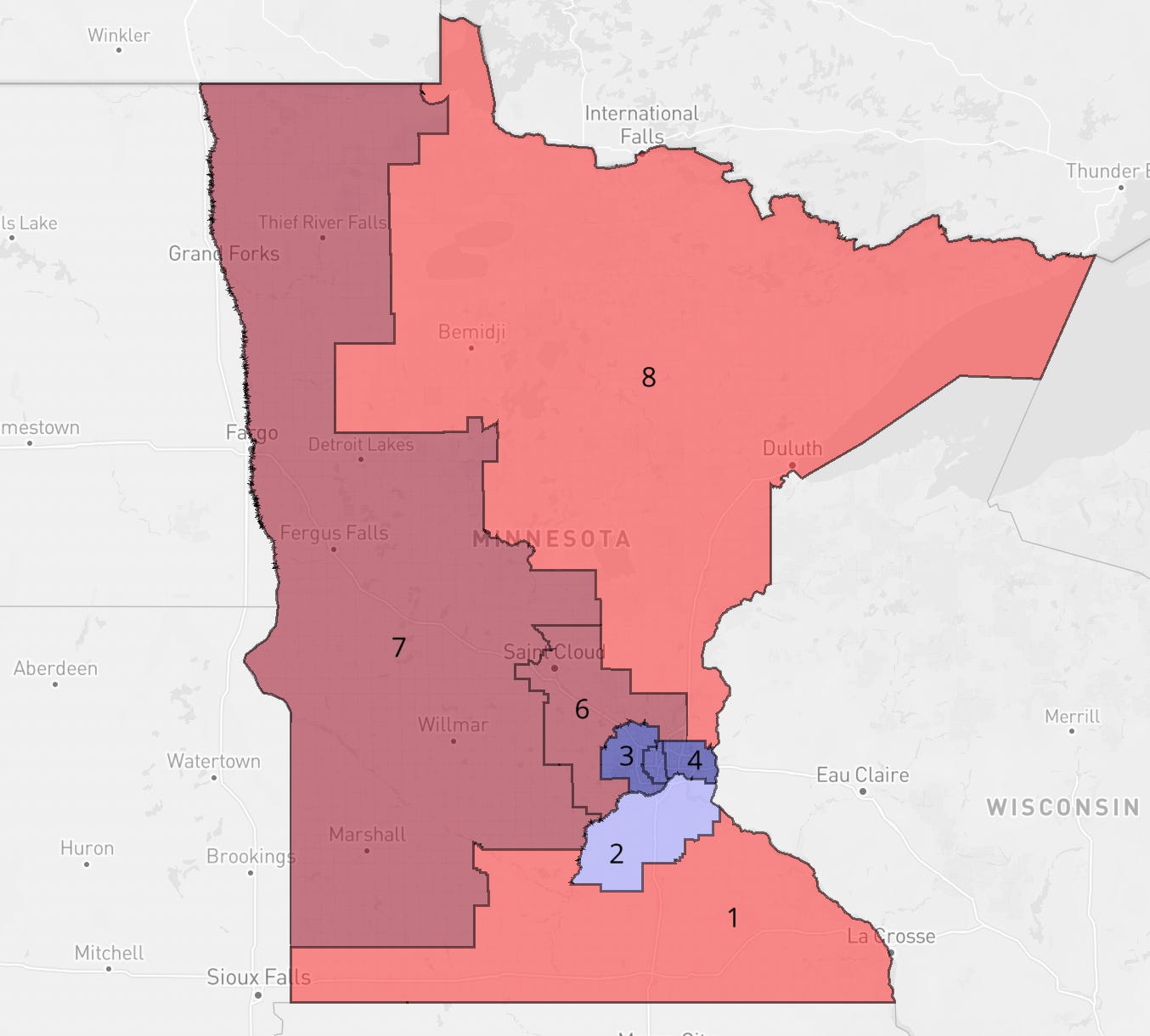
Current MN Map
Ordinarily, Minnesota Democrats would not redraw their maps mid-cycle, but given the chance to, Speaker Jeffries will try.
Procedurally, Democrats may have to climb certain hurdles to get there. First, Democrats legislative majorities are likely to not be very large, so one or two state legislators voting against redistricting may tank the effort. Secondly, there’s an open question as to whether or not the voters would have to approve new maps, as we saw in Virginia or California, or the legislature can redraw them without a vote. Finally, likely incoming governor Amy Klobuchar seems lukewarm on the idea.
I’ll let others handle procedural hurdles, but, in my opinion, some attempt at mid-cycle redistricting is fairly likely.
The question then becomes, what do the maps look like?
If the maps can be passed solely by the legislature, a map that elects seven Democrats and one Republican is plausible, and fairly easy to draw.
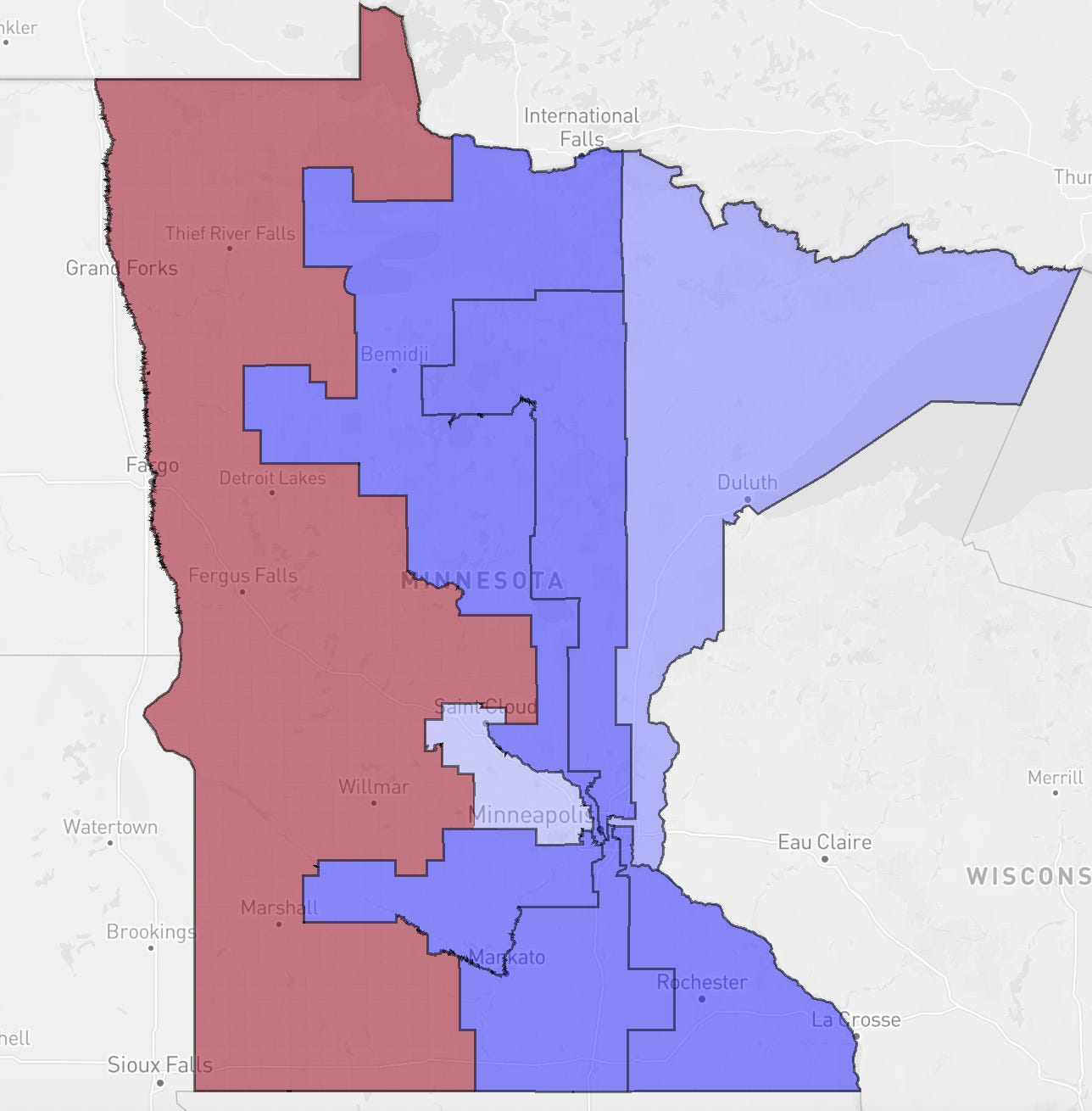
Model 7-1 MN Plan
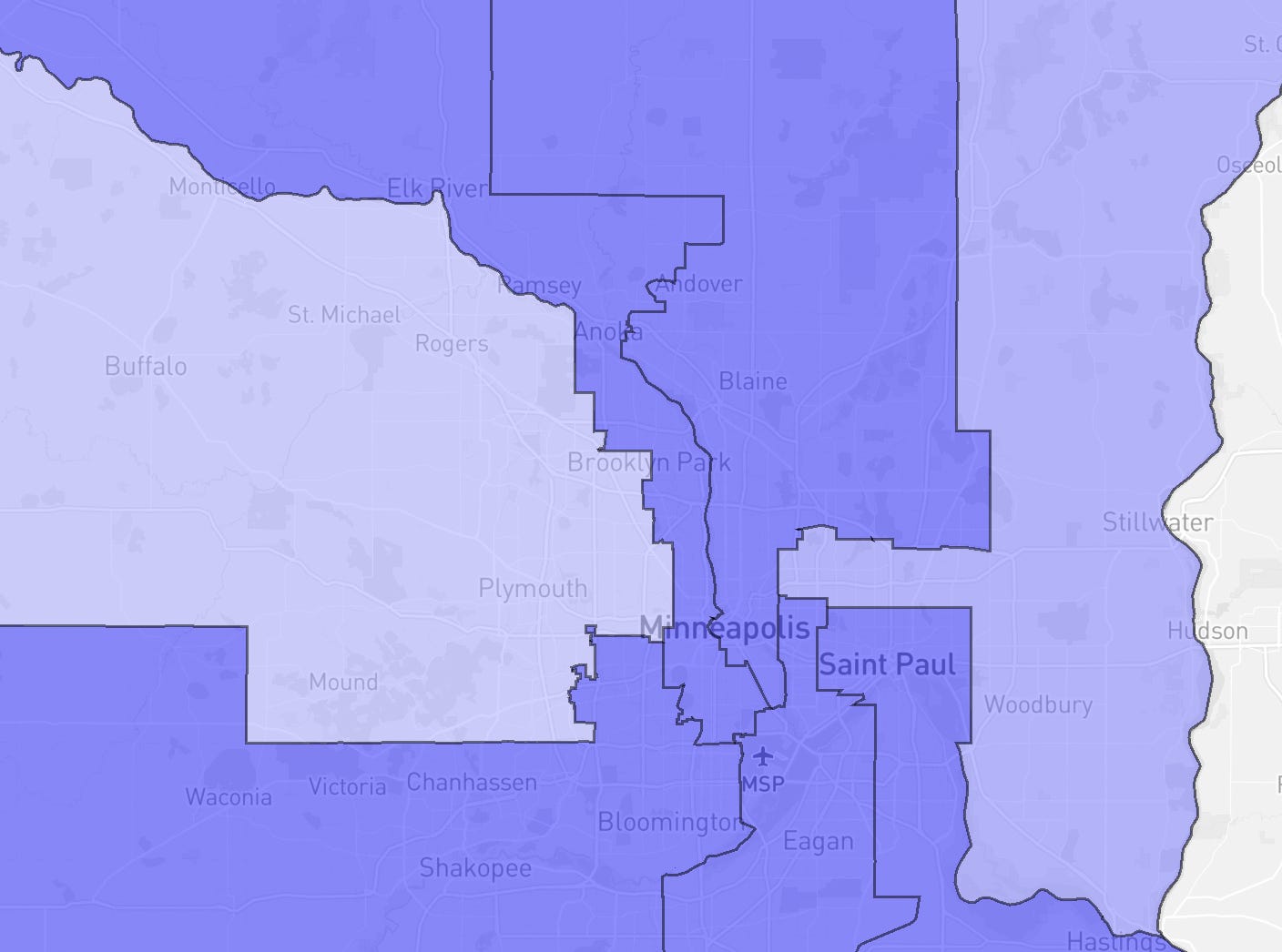
Minneapolis-St Paul Inset
Like the maps in Virginia, California and my map of Illinois, the districts must take a part of the Minneapolis-St Paul region and link them with smaller cities in rural Minnesota. To achieve a 7-1 split, the Minneapolis region is connected with smaller Democratic leaning cities in rural Minnesota, such as Duluth, Mankato and Rochester, which provide enough of a boost to draw 7 safe or Democratic leaning seats and one uber conservative Republican seat.
While many in Washington may like this plan, I think it’s unlikely to pass, especially if voted on by the public. In 2024, Minnesota voted for Vice President Harris by just 4%, the map is non-compact and disenfranchises rural Minnesotans. All similar to Virginia. Given how close the Virginia Amendment was, I believe Democrats will chose a safer route.
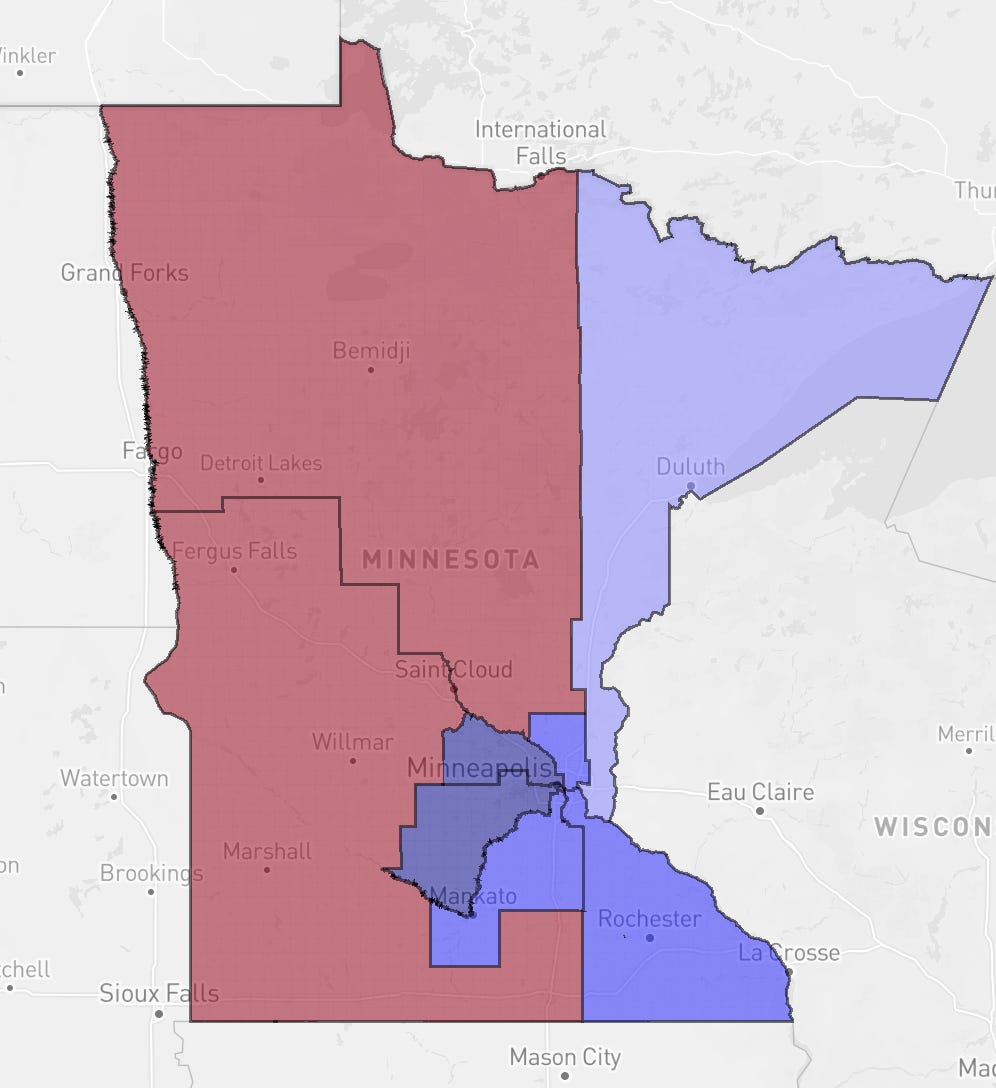
Model 6-2 MN Plan
Minnesota Democrats may opt to pass a much safer 6-2 Democratic map, eliminating two Republicans seats, as opposed to three. This map has fewer procedural and political hurdles, making it much more likely to pass.
Redistricting in Minnesota is far from guaranteed, but Democrats will almost certainly attempt it.
Wisconsin: Since 2011, Wisconsin has been extremely gerrymandered towards Republicans. When Republican Governor Scott Walker won and the legislature flipped Republican, Wisconsin Republicans drew egregious gerrymanders at the Congressional and State legislative level. Despite being a swing state, Democrats have not held a majority of Congressional seats or in either chamber since 2010.
2026 will change that. Since Democrats have flipped several Wisconsin Supreme Court races, state legislative lines have been redrawn giving Democrats new life legislatively. In 2024, Democrats picked up ten seats in the Wisconsin House and five in the Wisconsin Senate, though Republicans still have majorities in both chambers, Democrats will probably flip both this cycle.
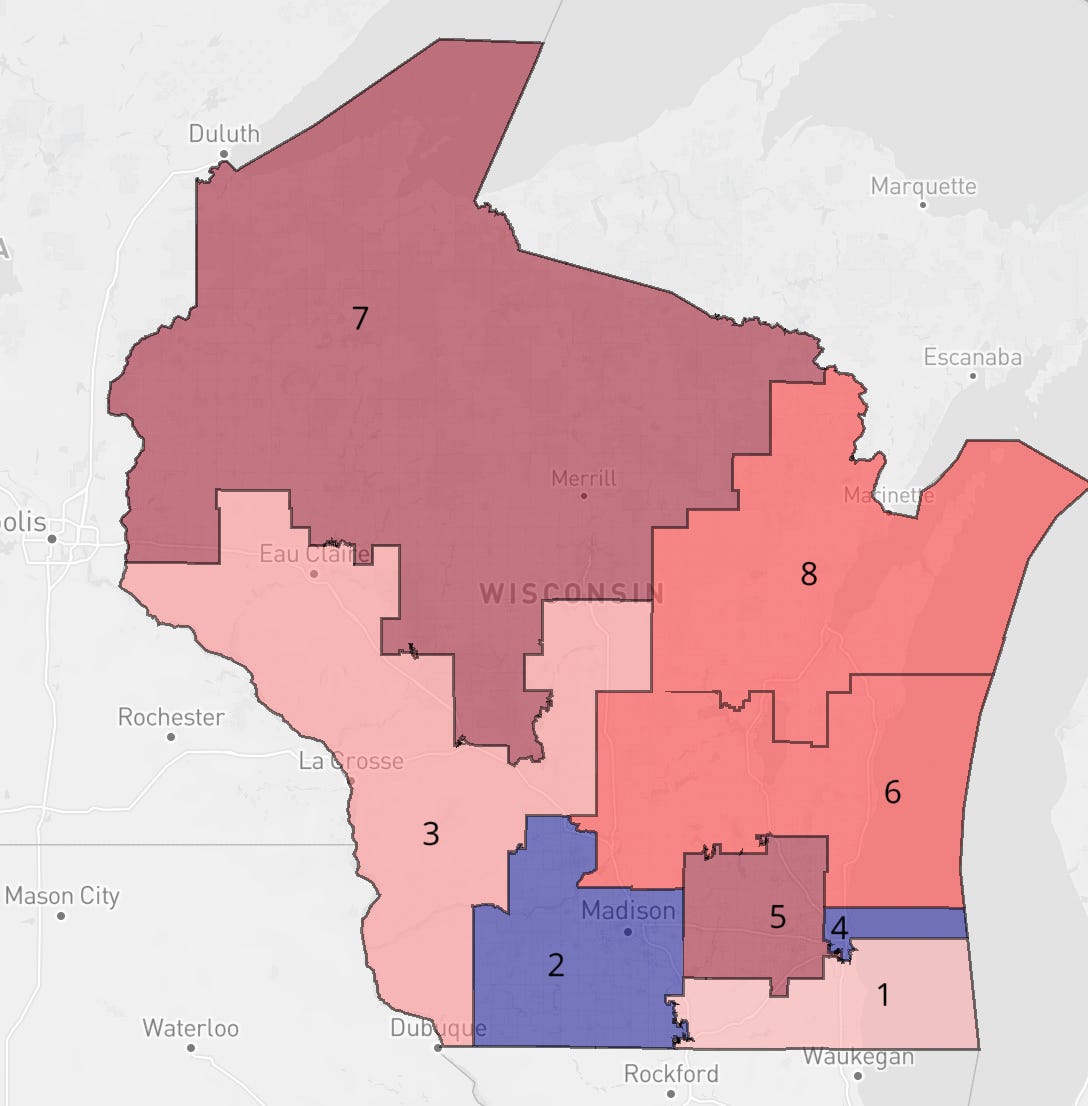
Current WI Map
Currently Democrats need to pick up two seats in the Wisconsin Senate and five in the Wisconsin House to flip both chambers. Not guaranteed, but Democrats are favored in both.
Finally, Democrats must retain the governorship. Outgoing Democratic Governor Tony Evers is popular and several prominent Democrats are looking to succeed him. Notables include former Lt. Governor, Mandela Barnes, Milwaukee County Executive David Crowley, State Representative Francesca Hong, and current Lt. Governor Sara Rodriguez.
Barnes and Hong are leading the pack currently, with both leading in polling and on prediction markets, with Barnes the favorite. Both Barnes and Hong are not guaranteed to win the general election against Trump endorsed Tom Tiffany, however. Barnes lost a close Senate Race in 2022, while Evers and other Democrats won at the top of the ticket. Hong, a democratic socialist has a past of saying controversial things, may not play well amongst Wisconsin’s more conservative electorate. That being said, Wisconsin Democrats still are very likely to hold the governorship.
So, what does a 6-2 map in Wisconsin look like?
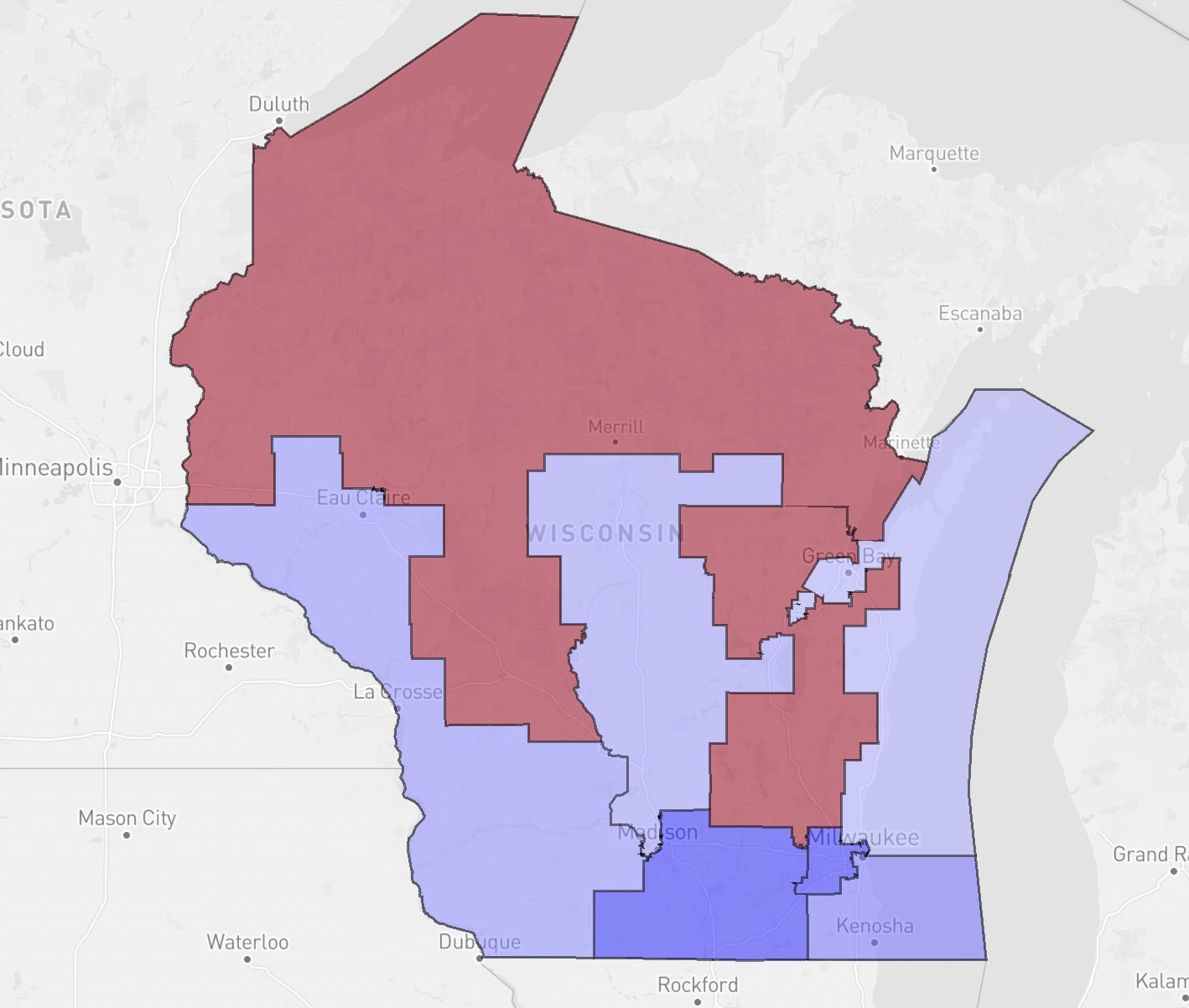
6-2 WI Map
Wisconsin Democrats are primarily concentrated in Milwaukee and Madison, two metro areas that, although very blue, have very Republican suburbs and rural areas surrounding them making the state harder to gerrymander for Democrats.
Much like other hypothetical gerrymanders, a 6-2 Wisconsin map involves splitting the urban areas in three, and combining them with smaller Democratic cities elsewhere in the state to ensure a 6-2 Democratic majority.
This is not guaranteed to pass, the Wisconsin supreme court may somewhat limit the damage Democrats can do and the Democrats legislative majorities will not be very large. However, I expect them to take a crack at mid-cycle redistricting, shifting at minimum two and at maximum four seats Democratic.
Colorado: The Democrats biggest untapped redistricting advantage is the state of Colorado. Once a swing state, the state lurched left in the 2020s voting for Harris by 11%, more than Illinois. However, the Colorado Congressional Delegation has not kept up. An early adopter of an independent redistricting commission, Colorado’s congressional delegation currently has four Democrats and Four Republicans.
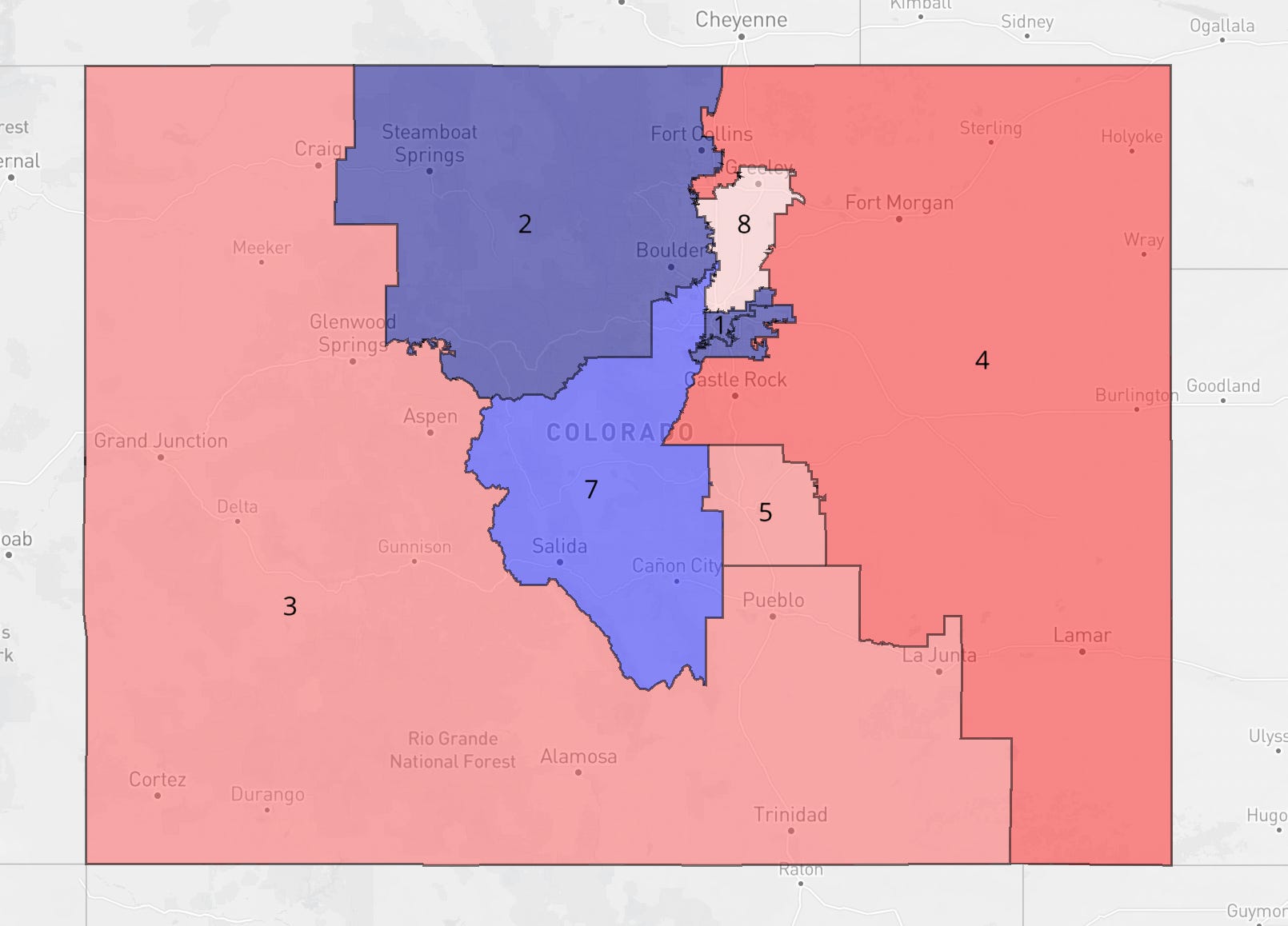
Current Colorado Map
Fueled by Democratic packs of Denver and Boulder, the independent commission managed to produce a Republican leaning map, despite the state becoming much more Democratic. A good example of this is Congressional District 1. Currently held by Democrat, Diana Degette, the district contains the entire city of Denver, making her seat Harris +56.
If Democrats unpack both Boulder and Denver, a 7-1 or even 8-0 map is possible.
To accomplish this Democrats will need a ballot initiative to suspend the commission and allow a Democratic drawn map to come into place. Both Democratic and Republican aligned groups are spending money on various ballot initiatives to accomplish or prevent this from happening, however, in all likelihood this initiative will need to come from the legislature itself in 2027.
Current term limited Governor, Jared Polis does not want to complete this process this year, however, Democratic gubernatorial candidates Michael Bennet, and Phil Weiser have both stated they want the legislature to pass this amendment in 2027.
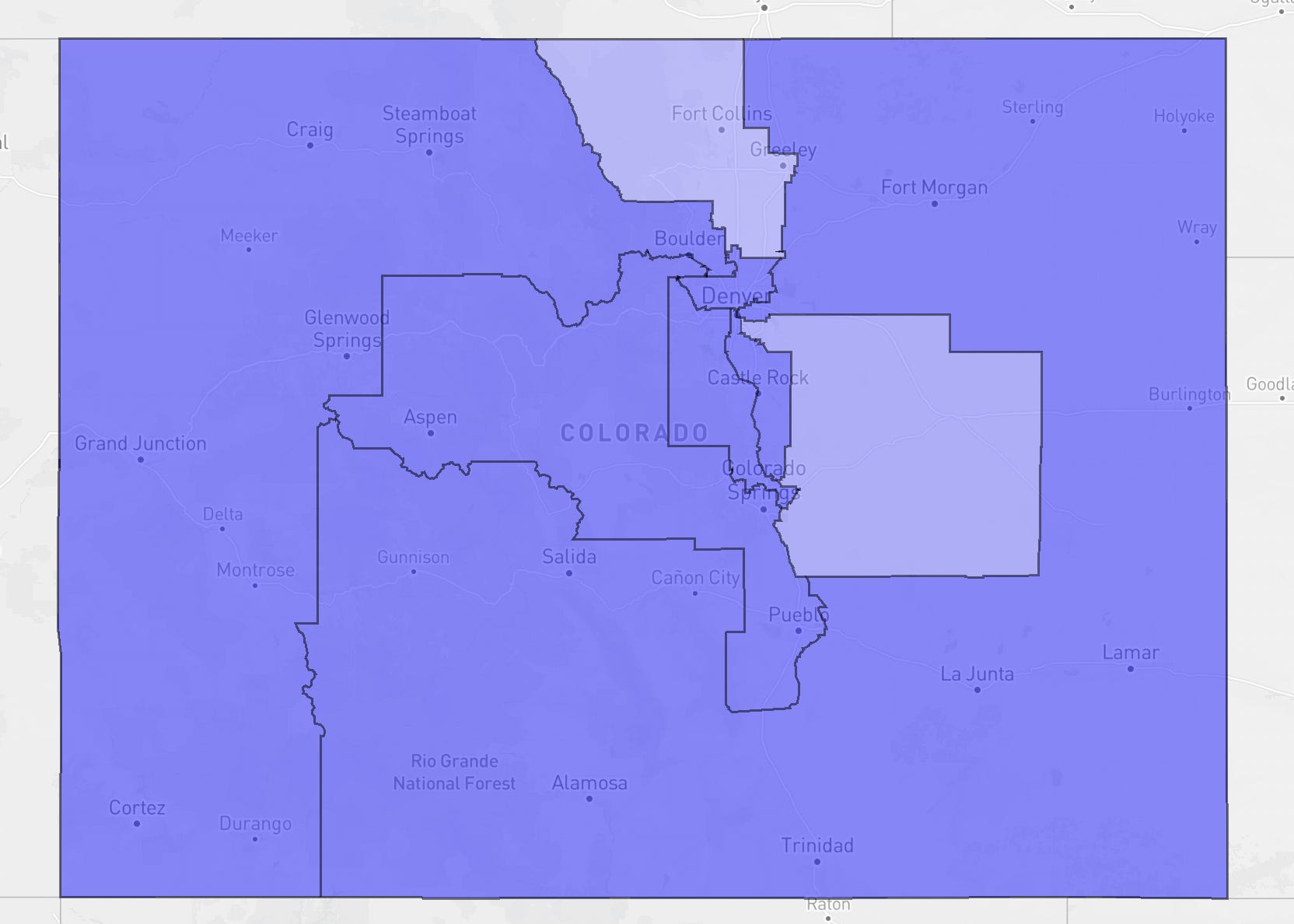
Model 8-0 CO Plan
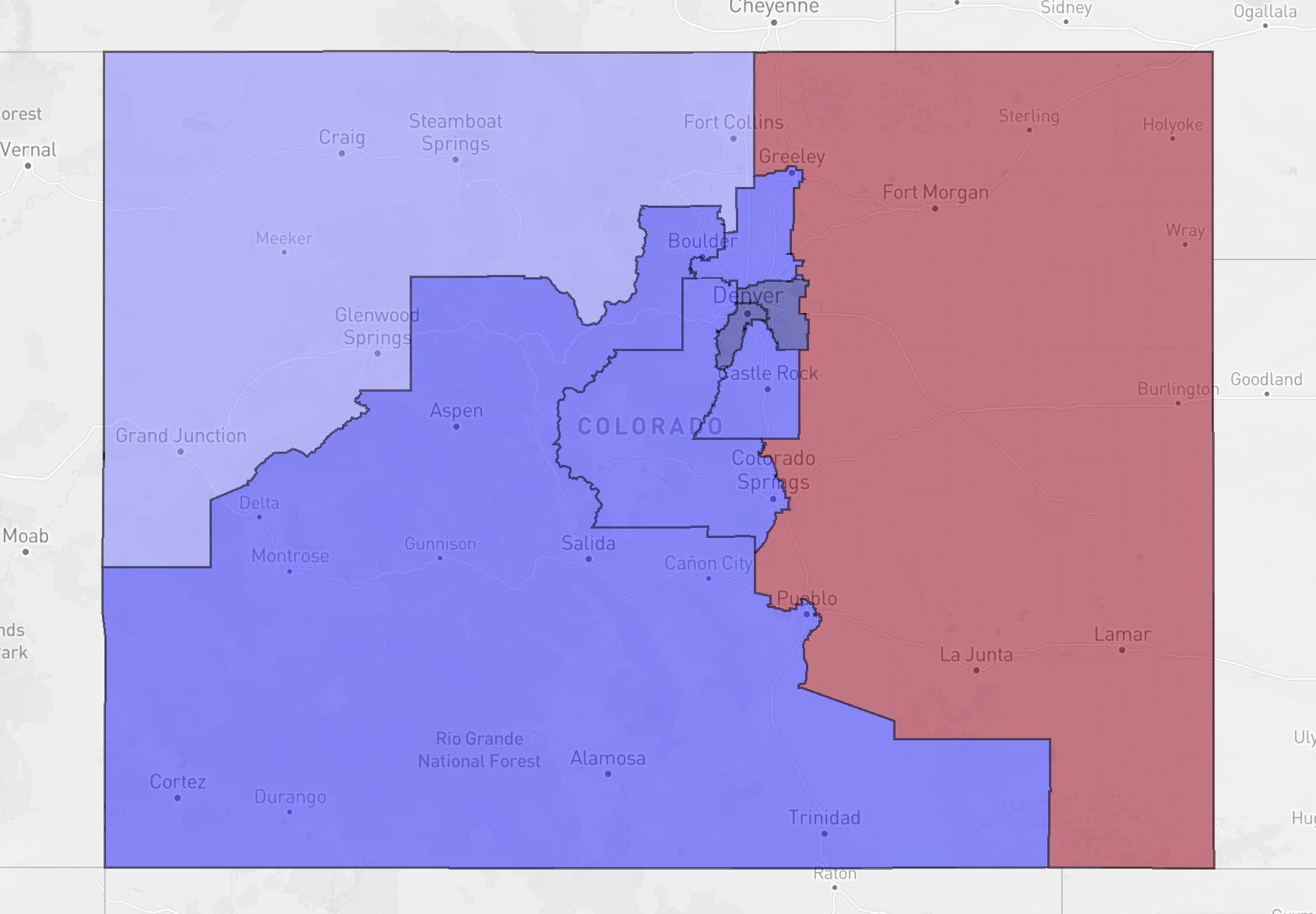
Model 7-1 CO Map
Above are model 8-0 plans and 7-1 plans. Both plans fairly safely eliminate all or almost all Republican leaning seats, albeit in different ways.
The question for Colorado Democrats is which is more sellable to the public? Colorado is so blue, the referendum likely will pass no matter what. But Democrats may opt to play it safe, only eliminating three Republican leaning seats as opposed to four.
Democrats have the ability to eliminate 11 Republican leaning seats across Colorado, Minnesota and Wisconsin. Given practical concerns, this number will be lower, but some of the most effective redistricting weapons exist in these states.
That’s all for today. Tuesday there will be a California Primary preview followed by Pt. 3 next week.