


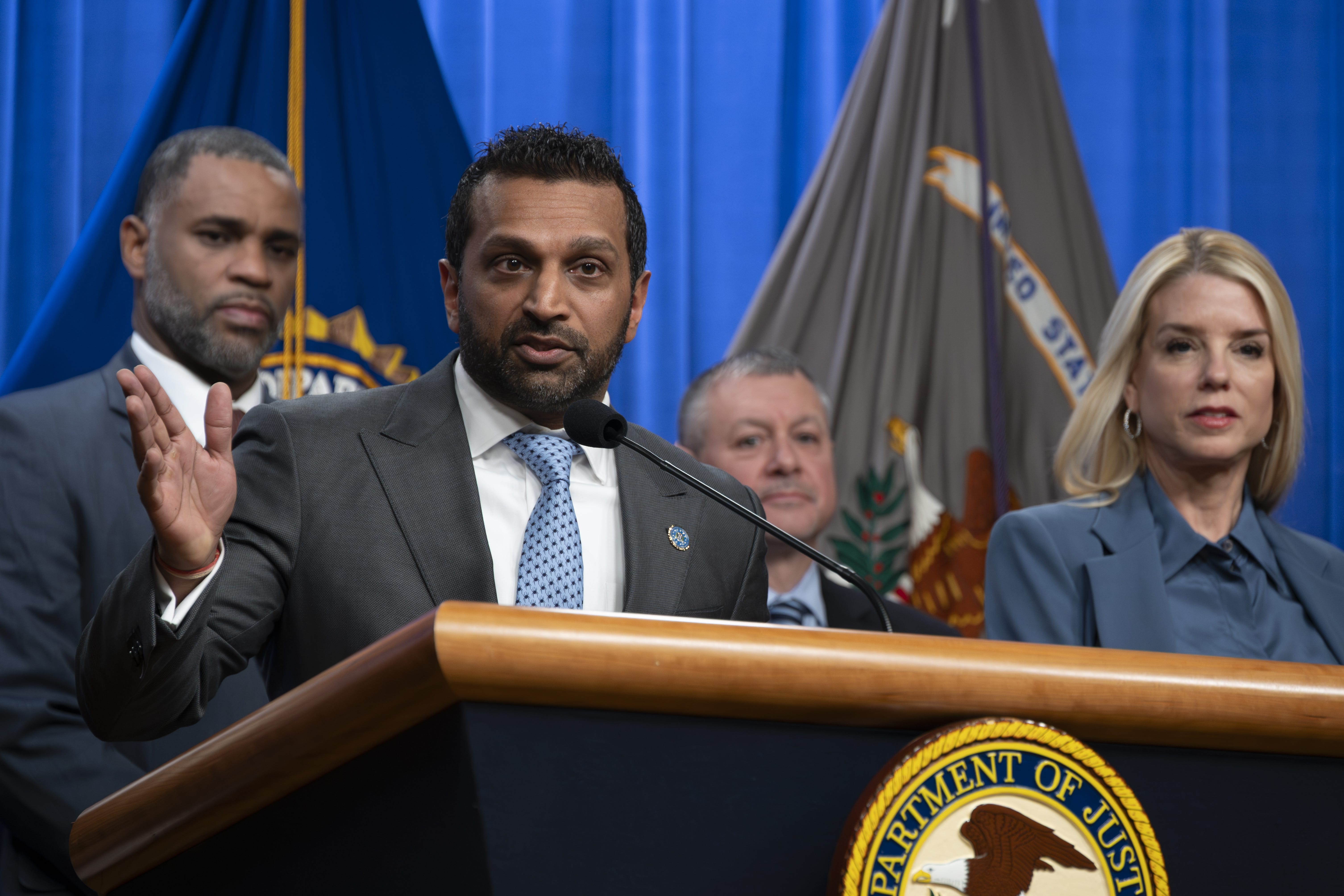
On December 4, 2025, the Justice Department announced that it had finally arrested the one January 6 criminal they care about: Brian Cole, Jr., the alleged DNC pipe bomber. On the dais for the half-hour victory rally were FBI Director Kash Patel and his then-deputy Dan Bongino, two former podcasters who previously claimed that the bombs were planted by Biden allies to distract from a “stolen” election.
Asked about this discrepancy by Fox News’s Sean Hannity, Bongino sulked that “I was paid in the past for my opinions. One day I will be back in that space but that's not what I'm paid for now.”
As of this week, he’s back in his safe space. Bingo, bango, Bye-o!
At the press conference, Bongino blustered that “this is what it’s like when you work for a president who tells you to go get the bad guys and stop focusing on other, extraneous things, not related to law enforcement.”
According to the Wall Street Journal, the break in the case came when someone at the FBI wrote a code to unscramble a cache of damaged cell tower data. There’s zero indication that this code went unwritten for five years because the FBI was in mandatory DEI training, and the Journal reports that agents expressed “resentment over FBI Director Kash Patel, who has suggested that they didn’t work doggedly on the probe until Trump administration leadership arrived.”
But that may wind up being the high water mark for this case, which has been prosecuted in truly shambolic fashion since being handed off to Jeanine Pirro, the US Attorney for DC.
Calendars are hard
On December 3, the DOJ filed a criminal complaint alleging that Cole, a 30-year-old man living with his mother in Virginia, traveled to DC on the eve of the Capitol Riot and planted crudely-constructed pipe bombs outside the RNC and DNC. But a criminal complaint is not an indictment; it merely allows the government to seek detention of a suspect and starts a 30-day clock to charge him.
Under Federal Rule of Criminal Procedure 5.1, a magistrate judge must also hold a preliminary hearing within 21 days to establish probable cause that the defendant committed the crime. But that almost never happens because a competent prosecutor will go to a grand jury and secure an ex parte indictment rather than participating in an adversarial hearing where the defendant gets to present evidence and interrogate the government’s witnesses.
No preliminary hearing was calendared here because all parties, including Magistrate Judge Matthew Sharbaugh, assumed that the DOJ would proceed expeditiously to a federal grand jury and seek an indictment. But for whatever reason, they didn’t.
On Christmas Eve, with no indictment on the horizon, Cole’s lawyers started tapping their watches and asking the DOJ what it planned to do about its obligations under Rule 5.1. On December 29, Assistant US Attorney Charles Jones admitted that there were no grand juries sitting in the US District Court for DC between December 19, 2025 and January 5, 2026, and thus there would be no federal indictment. Jones proposed scheduling the probable cause hearing for January 6 or 7, i.e. never, since by then, he’d have presumably managed to get an indictment. Cole’s lawyers responded that the government had to hold the probable cause hearing on December 30, or let him go home.
Before Judge Sharbaugh could rule, the DOJ showed up on December 29 with an indictment returned by a grand jury sitting in DC Superior Court.
Po-tay-to, po-tah-to?
In the infinite wisdom(?) of our nation’s founders, our seat of government is located in no state. And because DC is a non-state municipality, the US Attorney prosecutes crimes in DC Superior Court (the analog to state courts) as well as in the US District Court for DC. In the past, indictments returned by DC Superior Court grand juries have occasionally been accepted by federal judges. But Pirro’s office ran into trouble recently when it used the local grand jury as an end-run around the federal grand jury.
On September 26, after a federal grand jury no-billed an indictment of DC resident Kevontae Stewart for gun possession, Pirro’s office successfully shopped the case to a Superior Court grand jury instead. Magistrate Judge Zia Faruqui, who had expressed outrage at the DOJ for charging and then dropping so many garbage cases, refused to accept the indictment. After extensive briefing, he ruled that indictments from DC Superior Court are not valid in federal court.
The DOJ appealed, and Chief Judge James Boasberg ordered Judge Faruqui to accept the Stewart indictment. But, noting that “the public interest lies in letting the Court of Appeals decide this issue before the Government moves forward both on this case and in similar fashion on other cases,” he stayed the case pending Stewart’s appeal to the DC Circuit.
On December 30, Magistrate Judge Sharbaugh asked for briefing on whether he should accept the DC Superior Court indictment of Brian Cole in light of Judge Boasberg’s ruling in the Stewart case.
Sensing that the best defense was a good offense, Jones indignantly protested that the cock-up was all the defendant’s fault.
“In good-faith reliance on the representations of defense counsel of record, the government chose not to secure an early indictment in this case on or before December 19, 2025, the last date on which grand jury panels would be sitting in the District Court for the District of Columbia until January 6, 2026,” he whined. “The government would have sought such an early indictment from a federal grand jury panel had there been any indication that the defense, contrary to all indications, intended to pursue a preliminary hearing on December 30, 2025.”
To be clear: This indictment is not “early.” The defendant agreed to postpone the detention hearing and allow the government a few more days to get in front of a grand jury. That’s not an agreement to forego a preliminary probable cause hearing.
But the government pinky-promised that it would get a federal grand jury to bless this thing on January 6, and that was good enough for Judge Sharbaugh. Based on “the government's confirmation that it does not intend to use the Superior Court grand jury as an ultimate end-run around a federal grand jury empaneled by this Court,” he accepted the indictment in a one-paragraph minute order, obviating the need for a probable cause hearing.
Out of the frying pan …
After the indictment — or “indictment,” depending on your perspective — the case was assigned to Judge Amir Ali, ending Sharbaugh’s involvement. Landing on the docket of a former civil rights litigator who argued multiple Supreme Court cases on behalf of criminal defendants was either a lucky break or a potential disaster — again, depending on your perspective.
Cole’s lawyers promptly filed an emergency motion to un-accept the indictment and release their client because he never got his preliminary hearing. They characterized Judge Sharbaugh’s ruling as “conditional” and argued that his brief minute order “avoid[s] any legal analysis of the dispositive issue, which is whether a valid indictment has been returned in this case.”
Judge Ali ordered the government to respond by 5pm on Monday, January 5. Presumably prosecutors will race into the grand jury room on Tuesday morning and try to get a federal indictment before Judge Ali rules on Cole’s motion. Maybe that will moot the issue, and this prosecution can proceed normally. But it won’t change the fact that the DOJ spent three weeks flailing around because Pirro’s office couldn’t be bothered to present this high profile case to a federal grand jury before wandering off for vacation.
And right on time, the US Attorney is stumbling in to make it worse. In posts on Facebook and X, she wrote that Cole “gave a detailed confession to the charged offenses, telling law enforcement he was frustrated with both political parties.”
This is a ham-fisted effort to obscure the fact that Cole, who is on the autism spectrum, did what he did because he believed Trump’s lies about a stolen election — lies that Pirro herself was pulled off the air for fomenting. It will also feature prominently in an upcoming motion for a gag order to stop DOJ from poisoning the jury pool.
If we didn't know better, we'd think the DOJ was deliberately trying to tank this prosecution. Guess we'll have to wait for Dan Bongino to get back to podcasting and connect the dots for us.
I asked this on a previous post, but can you explain what is different between a DC grand jury and a federal grand jury? Aside from where the pool of jurors are drawn from, is a DC GJ easier to secure an indictment? I just feel like I'm missing a key piece of the story.
I agree. The last thing the administration wants is discovery. Why did Cole think the election was stolen? Did he coordinate with the other seditionists?